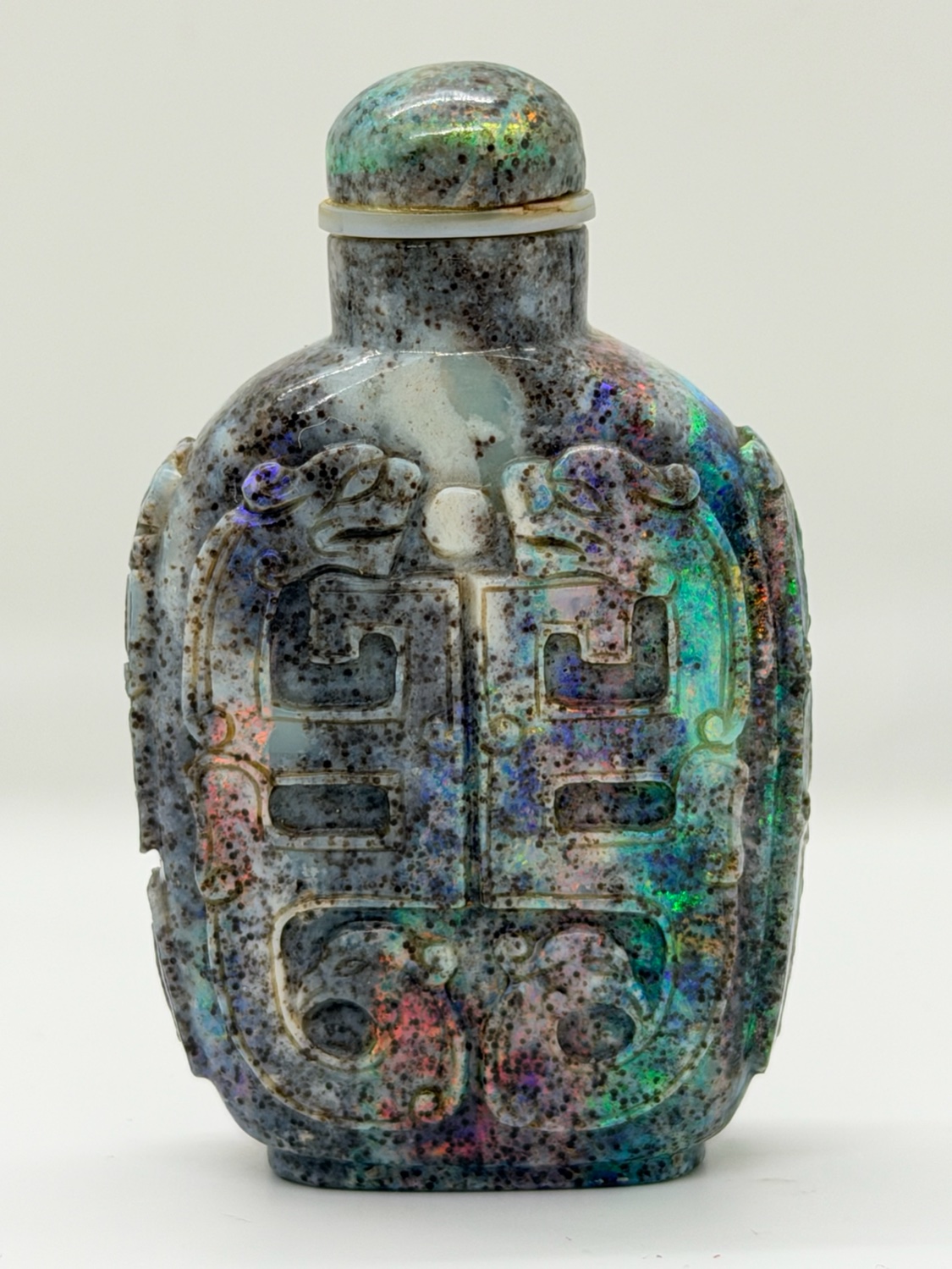
Chinese Carved Opal Snuff Bottle, Archaistic Taotie Design, Matching Opal Stopper
蛋白石雕饕餮紋鼻煙壺
- Category
- Stone 石質 · Opal 蛋白石
- Material
- Opal matrix
- Period
- Qing dynasty, late 19th–early 20th century
- Form
- Flattened rectangular, flat oval foot
- Decoration
- Relief-carved archaistic taotie / kui-dragon design on both faces, carved side panels
- Stopper
- Matching opal dome stopper with white collar
- Height
- 2.2 in (56 mm), not including stopper
- Condition
- Very good condition
- Notes
- Good hollowing, though not exceptionally well hollowed Meaning of the carving: the taotie beast-mask and kui-dragons are archaistic motifs copied from ancient ritual bronzes — an emblem of reverence for antiquity and a protective guardian design. Tradition also reads the taotie, a famously voracious beast, as a warning against greed. The material is boulder opal — precious opal in its ironstone matrix. Queensland boulder opal was marketed in London from 1890 and commercial mining peaked around 1895 (GIA, Gems & Gemology, Spring 1993), which fixes the earliest possible date for bottles carved from it. Bonhams has catalogued a near-identical format — an upright rectangular opal bottle carved in raised relief with dragons, 2¼ in (San Francisco, 15 April 2012, lot 5745).
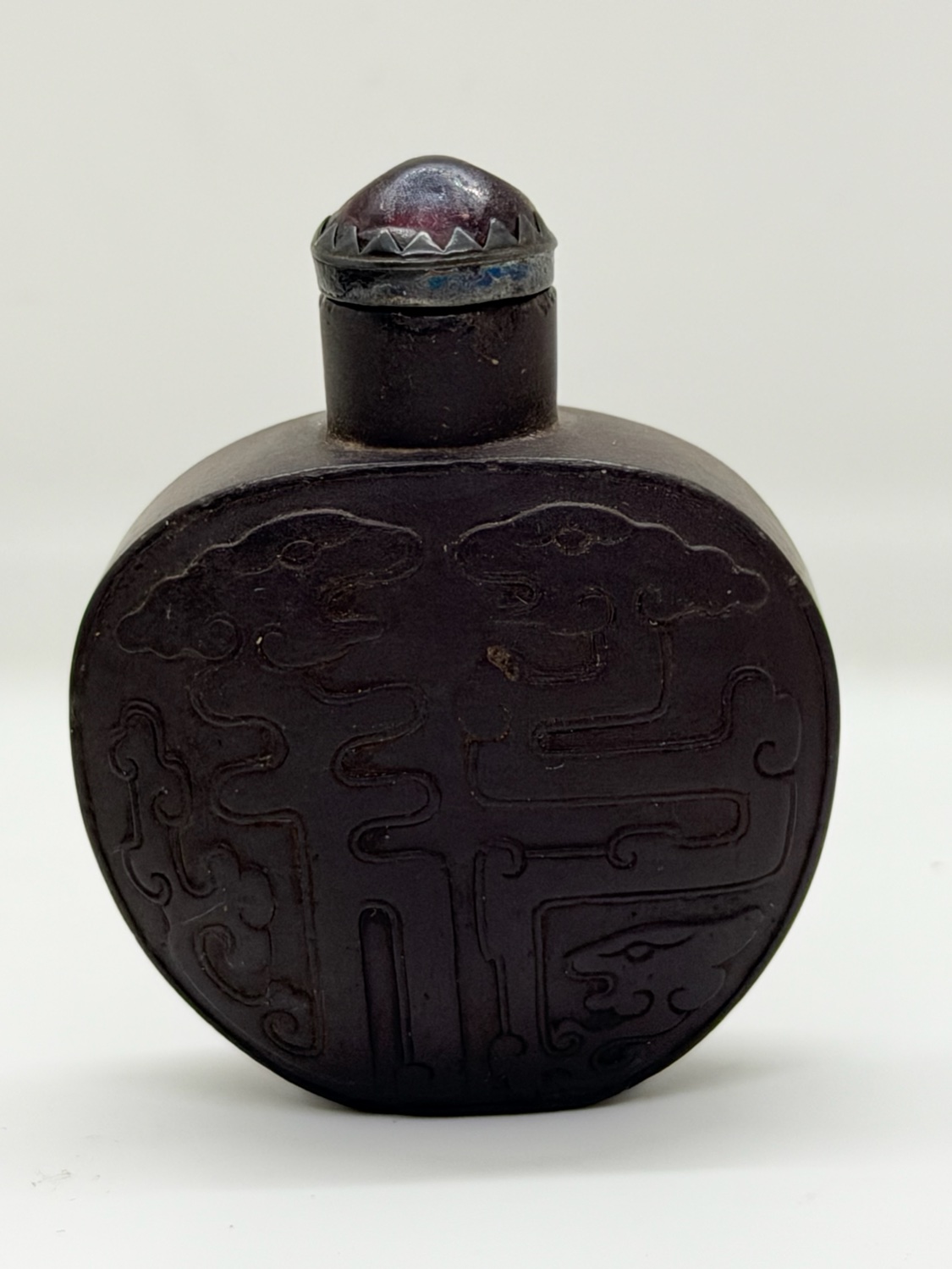
A Chinese snuff bottle carved from a single piece of opal matrix — boulder opal, the precious opal still locked in its ironstone host rock — of flattened rectangular form with rounded shoulders, a short straight cylindrical neck, and a flat oval foot. The stone is a mottled grey-blue densely speckled with black and dark brown matrix, with a vivid play-of-color — flashes of green, blue, violet, and red-orange fire across the surface, changing as the bottle is turned. Both principal faces are carved in relief, with some undercutting, with an archaistic design in the style of ancient bronzes: a symmetrical taotie composition built around a pair of confronted kui-dragons divided by a central vertical rib, with a round boss between the two dragon heads at the top, squared scrollwork in the middle register, and a pair of stylized beast heads at the base. As Bonhams notes of a formalised taotie design, the mask's elements double as other creatures — the horns read as simplified kui-dragons — so mask and dragon merge into one archaistic pattern. The narrow sides are also carved, each with a small archaistic dragon above panelled squared spirals (leiwen, the thunder pattern). The bottle is fitted with its matching domed opal stopper, set on a white collar. Date: Qing dynasty, late 19th to early 20th century — the Australian boulder opal the bottle is carved from only became available after opal mining began there in the late 1800s; GIA records that Queensland boulder opal was first marketed in London in 1890 and that commercial mining peaked around 1895, and carved opal bottles of this type — Case Antiques dates a comparable carved boulder opal bottle "Late 19th/Early 20th century", and Bonhams has catalogued an upright rectangular opal bottle carved in raised relief with dragons at almost exactly this height — are consistently dated to that period. The bottle is hollowed to a good standard, though not exceptionally well hollowed. The foot is a flat oval foot; the base shows the opal matrix in the rough — a speckled field flashing blue, green and pink fire.
中文說明
這件中國鼻煙壺由一整塊蛋白石(歐泊)基質雕刻而成——即礫石蛋白石,貴蛋白石仍嵌於鐵石母岩之中——呈扁平長方形,圓肩,短直圓柱形頸,平橢圓形底足。石材質地為灰藍色,密布黑色和深棕色基質斑點,表面帶有鮮豔的變彩——綠色、藍色、紫色和紅橙色的火彩交相閃爍,隨著瓶身轉動而變化。瓶身兩面均以浮雕手法雕刻仿古紋飾,局部帶剔地,取古代青銅器之風格:對稱的饕餮紋布局,由一對相向的夔龍組成,中間以一道豎棱分隔,頂部兩龍頭之間有一圓形乳釘,中部為方形卷曲紋,下部為一對獸首紋。正如邦瀚斯論一件程式化饕餮紋作品所言,獸面的各個元素本身又可作他物解讀——其角即簡化的夔龍——獸面與夔龍遂融為一體。瓶身兩側窄面亦有雕刻,各有一條仿古小龍,下方為方形雷紋。配有原配的同料蛋白石穹頂蓋,蓋下襯白色領圈。年代:清代,19世紀晚期至20世紀早期——此瓶所用的澳大利亞礫石蛋白石基質,是在19世紀晚期當地開始開採蛋白石之後才得以流通的;據美國寶石研究院(GIA)記載,昆士蘭礫石蛋白石於1890年首次在倫敦上市,商業開採約在1895年達到高峰;此類蛋白石雕刻鼻煙壺——Case Antiques曾將一件同類礫石蛋白石雕刻鼻煙壺定為「19世紀晚期至20世紀早期」,邦瀚斯亦曾著錄一件高度相近、浮雕龍紋的長方形蛋白石鼻煙壺——其年代也一貫定於這一時期。瓶身掏膛良好,但不算極佳。紋飾寓意:饕餮與夔龍為仿古紋飾,取法上古青銅禮器,象徵崇古與守護;饕餮性貪,相傳亦寓戒貪之意。底足為平削橢圓足,足面保留蛋白石基岩的天然質感,斑點間閃爍藍、綠、粉紅火彩。
Comments & Contact 留言與聯絡
Questions or comments about a piece in the collection are welcome · 如對藏品有任何問題或留言,歡迎聯絡。
Leave a comment 留言